
Run payroll with the checks an auditor will actually ask for.
Fiscus is automated payroll software for Nepali organisations. Each month it works out what every person should be paid, basic salary, allowances, Social Security Fund contributions and income tax, gets that checked and approved by several people, prepares the bank payments, tracks them until they are done, and keeps a permanent record.
What Fiscus does
- Calculates pay for each person in Nepali (BS) months, with prorating for joiners, leavers and unpaid leave.
- Applies SSF and income tax (TDS) from rule sets your accountant can check and update. Nothing about tax is hidden in the program.
- Requires different people to prepare, approve and release a payroll, so no single person can pay out money alone.
- Produces payslips (PDF), reports, a bank file or tracked payments, and a list of SSF and tax deposits with due dates.
- Records every sensitive action in an audit log that cannot be edited.
What Fiscus does not do
- It never holds your money. Salaries are paid from your bank account, and your bank still asks your authorised signatories to approve.
- It does not log in to your bank. You never give Fiscus your bank password.
- It does not file returns with the Inland Revenue Department or SSF. It tells you the amounts and due dates, and you record the deposit when you have made it.
A real system, not a mockup.
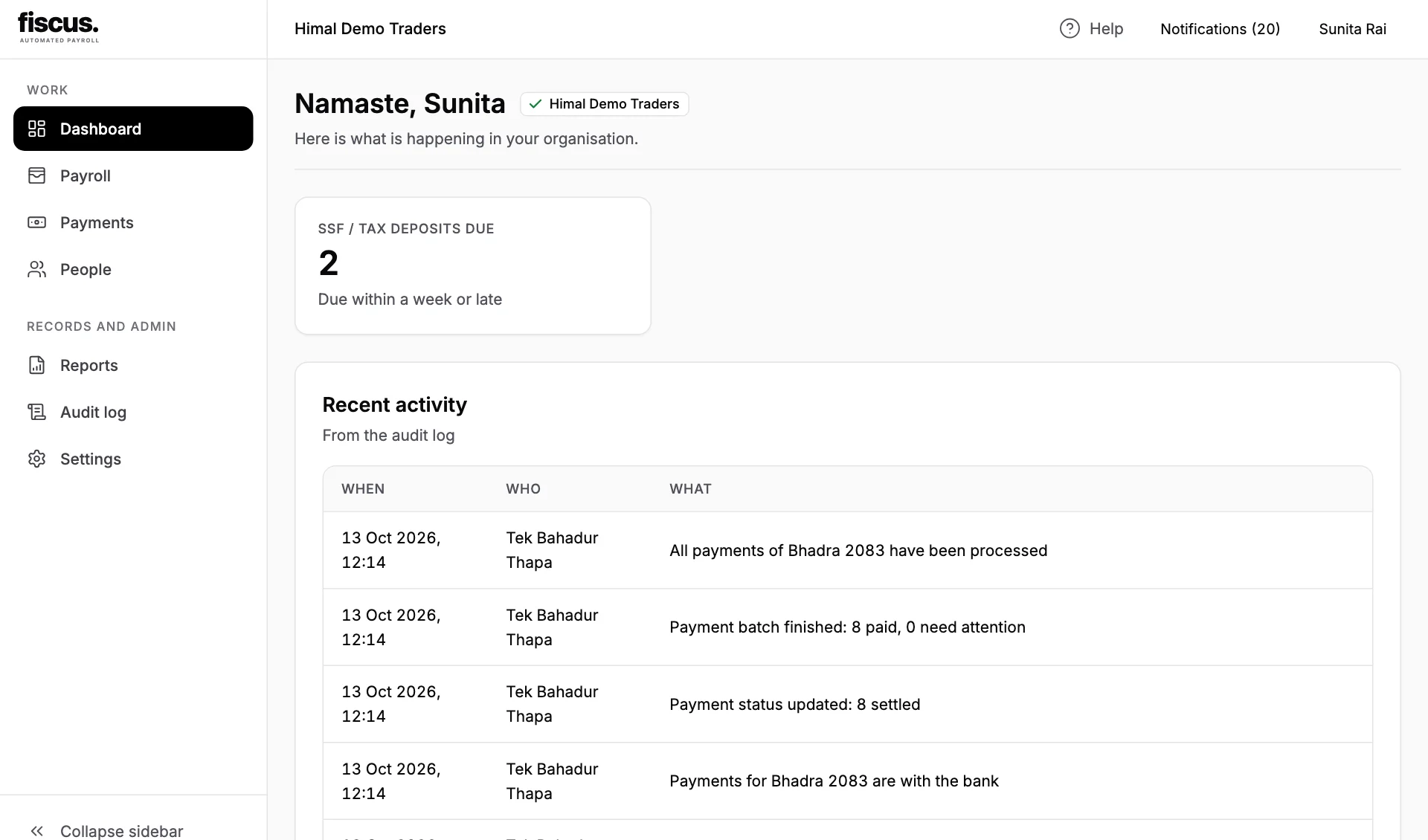
The dashboard: what needs doing, and what just happened.
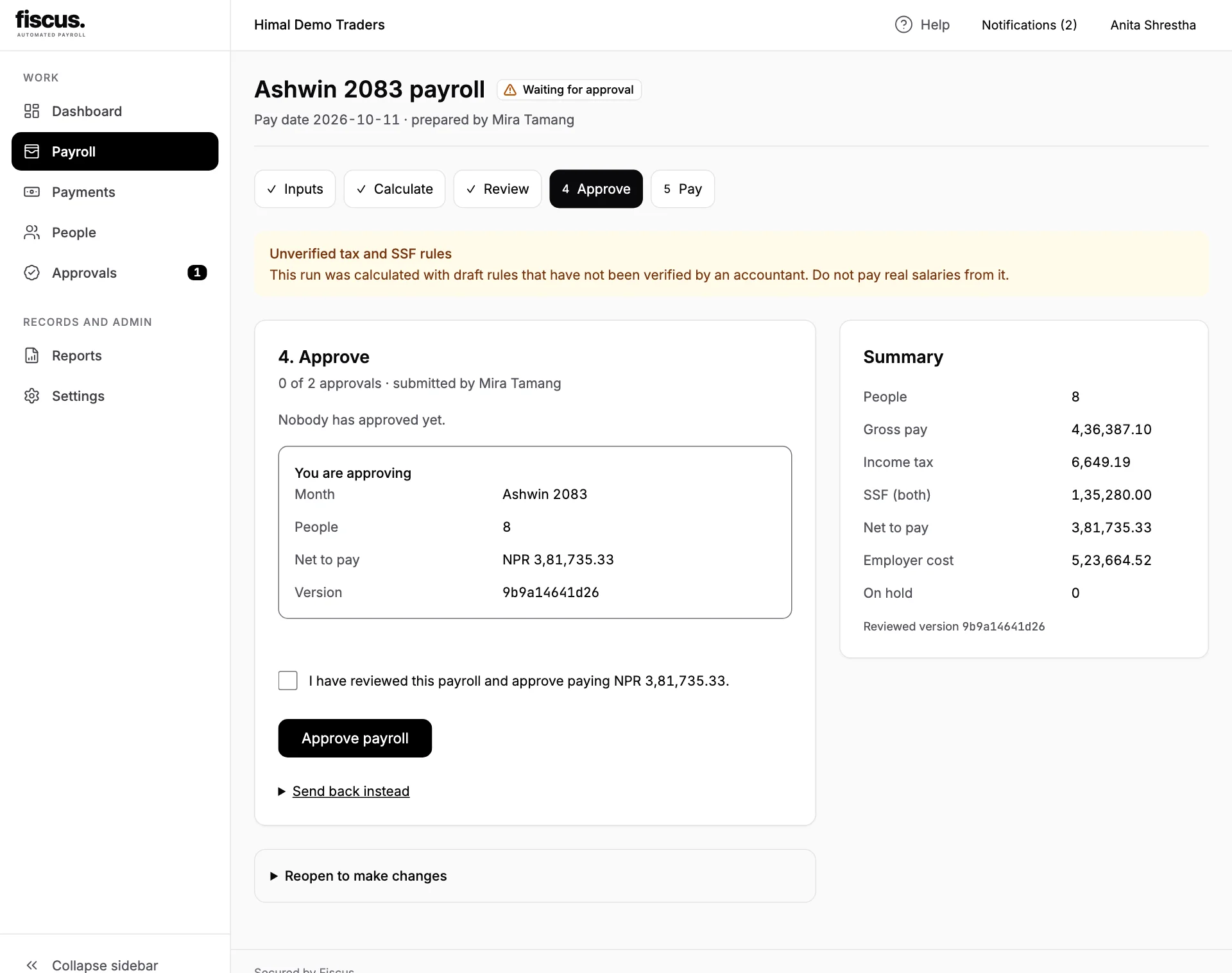
Approve, tied to a version fingerprint of exactly what was reviewed.
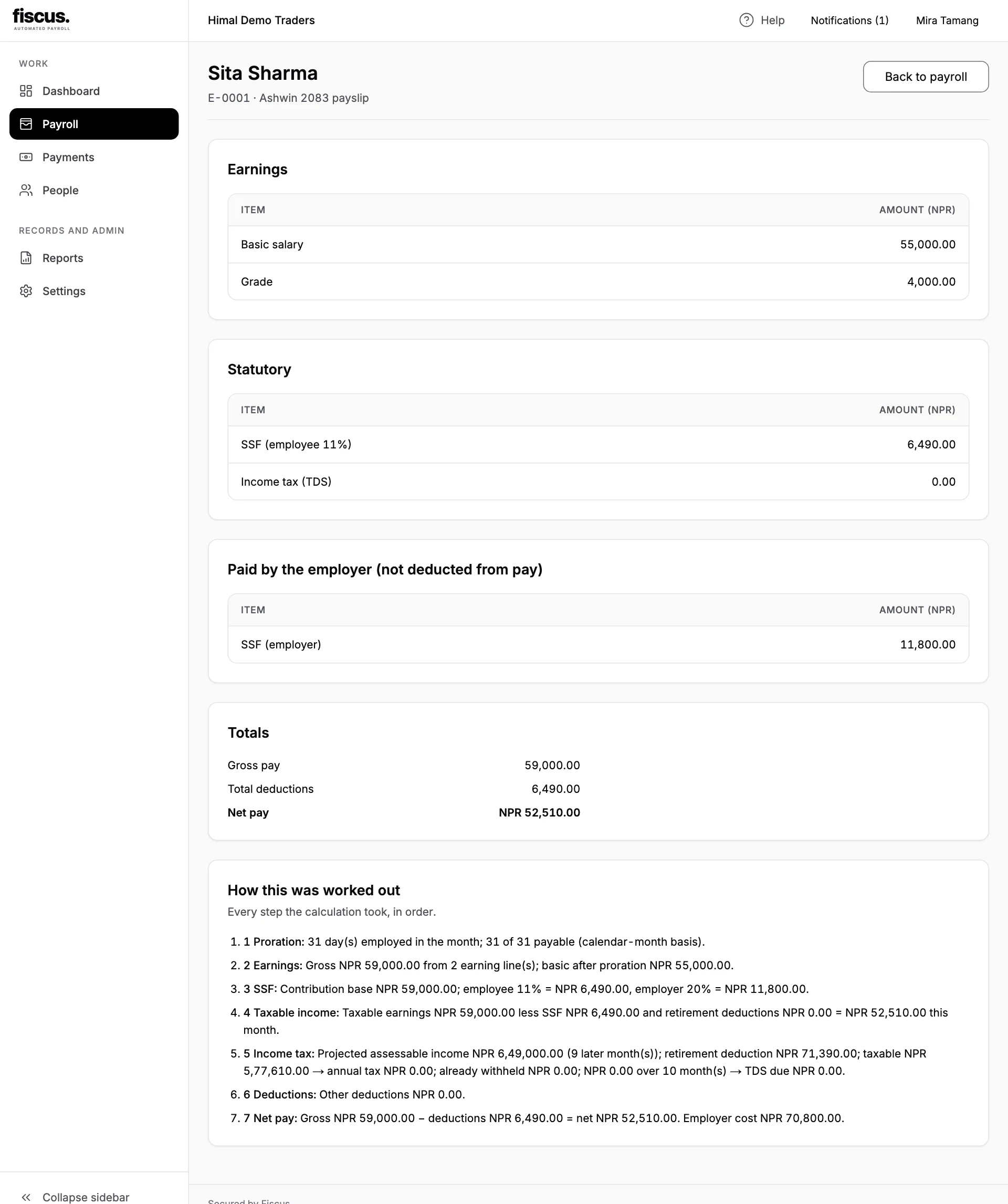
Every payslip carries its own calculation trace, line by line.
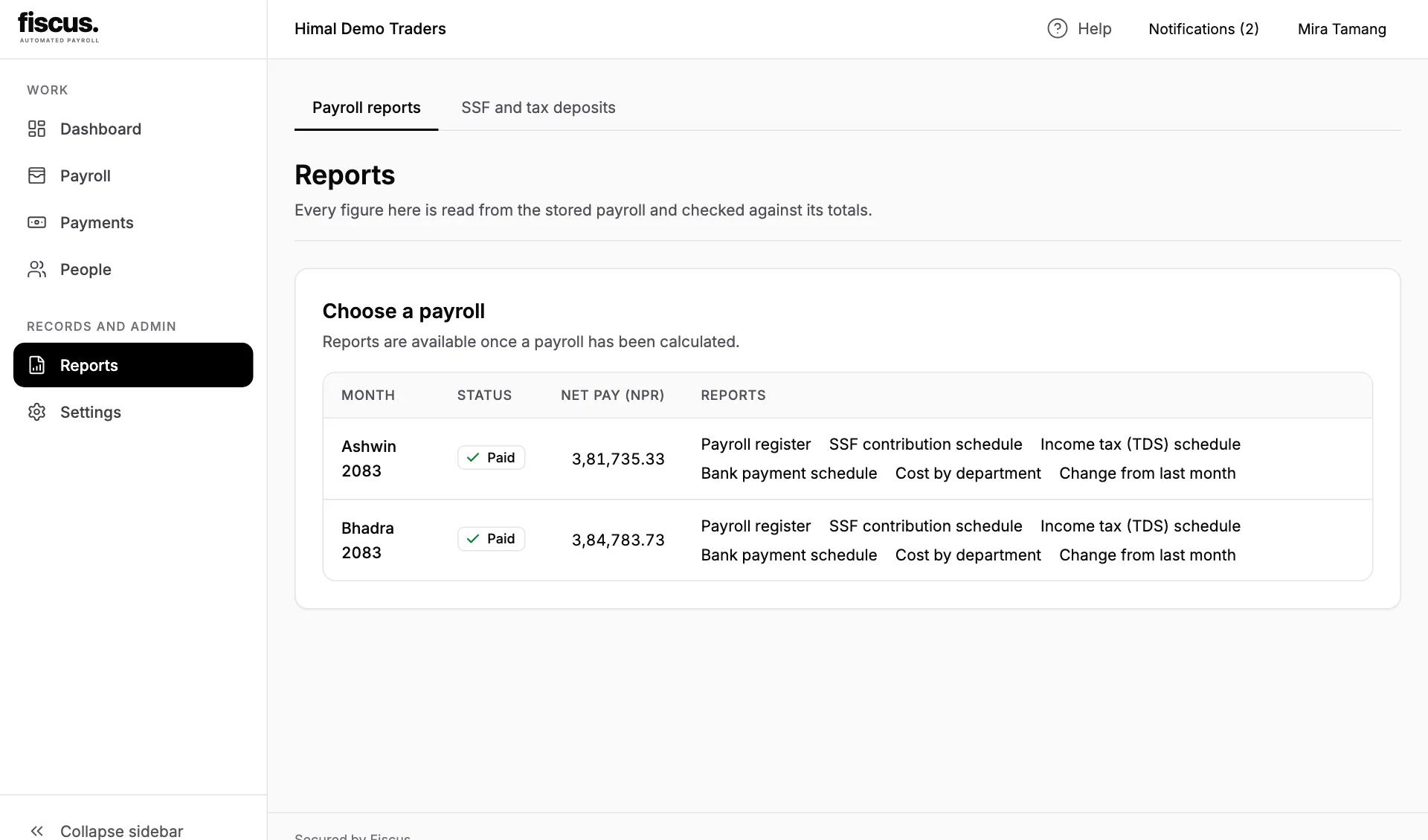
Reports checked against the payroll's own totals, to the paisa.
The monthly cycle.
- 01
Inputs
Unpaid leave, overtime, one-off amounts and holds are entered. The run starts in Draft.
- 02
Calculate
Fiscus works out gross pay, SSF, tax and net pay for every person.
- 03
Review
Changes from last month are compared, exceptions are explained, and the payroll is submitted.
- 04
Approve
Two or three people approve, depending on the amount. Nobody approves their own work.
- 05
Lock
The figures and payments are frozen. Nothing, including Fiscus staff, can edit them after this.
- 06
Release
Payments go out from your funding account, with a password confirmation and a typed RELEASE.
- 07
Reconcile
Payments are tracked until paid, matched against the bank statement, and the payroll is closed.
Who does what.
Every person has one or more roles, and the same person can hold several, but Fiscus still refuses to let one person do two steps of the same payroll.
Manages users, the approval policy, funding accounts and security. Does not run payroll, approve or release, by design.
Starts the monthly payroll, enters inputs, calculates, reviews, submits and locks it.
Reviews a submitted payroll and approves or sends it back. Cannot approve a payroll they prepared.
Sends the approved payments and reconciles with the bank. Cannot release a payroll they prepared or approved.
Adds and edits people, their pay and bank-account change requests.
Checks a new bank account against the employee's bank letter before it can be used.
Reads payrolls, reports and the audit log, and exports it. Cannot change anything.
Basic salary, allowances, SSF contributions and income tax worked out automatically each month, with prorating for joiners and leavers.
Separate people prepare, approve and release every payment, and a payroll cannot be changed once it is locked.
Every sensitive action is recorded in a log that cannot be edited, ready for whenever an auditor asks.
Required for owners, approvers and releasers before they can sign in — an authenticator app or a passkey, not just a password.
A changed bank account is checked by a second person, then waits 72 hours before it can be used, so a salary cannot be redirected on payday.
Approving, releasing or changing a bank account asks for your password again, every time, not just at sign in.
Fiscus is one of the products we build and run ourselves, to the same standard as everything we build for clients: understand the problem first, design before we code, and build for the long run.